7 Proven Strategies for Scalable Headless CMS Architecture
Published 19 May 2026·14 min read
On this page
Today, modern businesses demand exceptionally high performance from their digital platforms. Consequently, implementing a scalable headless CMS architecture remains absolutely vital for long-term operational success. Many technical founders still struggle daily with outdated, heavily bloated monolithic platforms. However, relying on these legacy systems actively stifles technical innovation. In fact, achieving true digital transformation requires a fundamentally contrarian approach to software engineering.
Specifically, industry leaders must prioritise sustainable performance over fleeting technological hype. Therefore, adopting a scalable headless CMS architecture provides the ultimate foundation for future growth. Furthermore, this decoupled setup allows engineering teams to integrate custom LLMs seamlessly. Ultimately, decision-makers can build highly resilient ecosystems that actually drive measurable enterprise value.
Additionally, designing a future-proof technology stack demands rigorous discipline and foresight. For instance, generic AI wrappers often introduce massive technical debt quickly. Instead, a scalable headless CMS architecture supports robust design systems naturally and efficiently. Thus, business owners gain absolute control over their complex content workflows. Let us explore several essential strategies to master this framework.
The Core of Scalable Headless CMS Architecture
First, we must define what makes a digital system truly resilient. A scalable headless CMS architecture strictly separates the backend content repository from the frontend presentation layer. Consequently, developers can deliver data across any device using highly robust APIs. Moreover, this separation of concerns significantly enhances baseline website speed. Ultimately, your engineering team gains unparalleled technical freedom to innovate.
Furthermore, this contrarian approach prioritises sheer maintainability over flashy features. Many generic solutions promise overnight success without delivering true stability. However, a scalable headless CMS architecture focuses exclusively on long-term operational endurance. In particular, it empowers enterprises to deploy bespoke user experiences globally without friction. Therefore, decision-makers should view this robust framework as a critical strategic asset.
Additionally, technical founders deeply appreciate the strict decoupling of core services. For example, updating the frontend design does not disrupt underlying backend data structures. Similarly, editors can manage content without worrying about complex frontend deployment cycles. As a result, a scalable headless CMS architecture drastically reduces internal systemic bottlenecks. Clearly, this necessary paradigm shift completely redefines modern digital ecosystems.
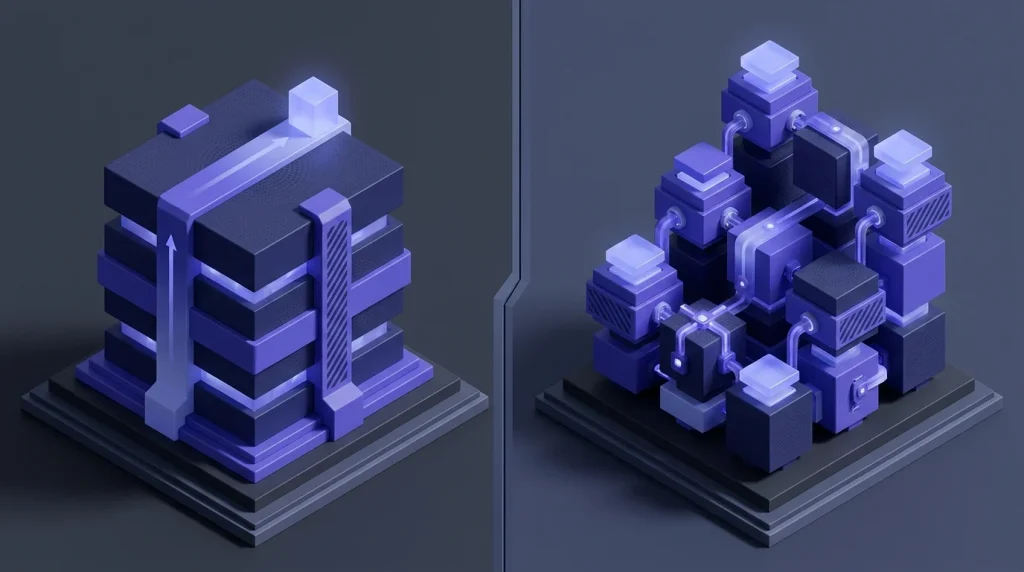
Monolithic Systems vs Scalable Headless CMS Architecture
Historically, large organisations relied heavily on all-in-one monolithic software platforms. Indeed, these traditional systems bundled the database, logic, and interface tightly together. While initially convenient, they quickly become rigid under heavy enterprise workloads. Consequently, scaling these monolithic environments often requires incredibly expensive, painful database migrations. In contrast, modern engineering demands far greater structural flexibility.
Therefore, migrating to a scalable headless CMS architecture solves these systemic flaws permanently. Specifically, lightweight REST or GraphQL APIs power the communication between decoupled systems. Furthermore, this distinct modularity allows teams to swap out failing components seamlessly. Meanwhile, monolithic platforms lock vulnerable businesses into restrictive single-vendor ecosystems. Thus, a scalable headless CMS architecture guarantees total operational independence.
Moreover, independent performance metrics consistently favour the strictly decoupled approach. For instance, detailed industry tests show headless websites load significantly faster than monolithic alternatives. As a result, better page speed directly improves both user engagement and organic search rankings. Clearly, embracing a scalable headless CMS architecture actively protects your baseline revenue. Ultimately, this structural shift entirely eliminates legacy technical debt.
Where Traditional Monolithic Fails Today
First, traditional monolithic platforms struggle severely with omnichannel content delivery. Specifically, engineers designed these older systems primarily for standard desktop web browsers. Consequently, pushing complex data to mobile apps or IoT devices becomes incredibly cumbersome. Furthermore, developers must invent fragile workarounds to bypass these hardcoded system limitations. Ultimately, these messy hacks destabilise the entire underlying digital ecosystem.
Additionally, rigid monolithic architectures inherently block rapid technological innovation. For example, integrating modern front-end frameworks like React or Vue proves notoriously difficult. Instead of innovating naturally, developers waste valuable time fighting the restrictive core platform. Therefore, this constant friction actively drains critical engineering resources and budget. In short, legacy systems simply cannot support modern SaaS dashboard UX requirements.
Finally, dangerous security risks multiply rapidly within tightly coupled digital environments. Because every component connects deeply, a single vulnerability easily exposes the entire application. Conversely, separating architectural layers naturally limits the potential security blast radius. Thus, business owners must clearly recognise the hidden dangers of older monolithic setups. Clearly, implementing a scalable headless CMS architecture provides this critically necessary foundation.
Why Scalable Headless CMS Architecture Wins
Conversely, a scalable headless CMS architecture thrives on pure technological adaptability. By leveraging independent microservices, technical teams can deploy targeted updates completely independently. Consequently, pushing a new software feature takes minutes rather than agonizing weeks. Moreover, this extreme agility directly supports modern continuous integration and deployment pipelines. Ultimately, agile businesses can iterate much faster than their slower competitors.
Furthermore, this flexible framework inherently supports integrating best-in-class developer tooling. For instance, programmers can choose the absolute best frontend framework for any specific job. Similarly, content management teams can utilise the most intuitive backend administrative interface. Therefore, a scalable headless CMS architecture completely satisfies both engineering and marketing departments. Indeed, this dual satisfaction dramatically boosts overall team productivity.
Additionally, API-first software designs ensure perfectly seamless third-party service integrations. Whether adding custom LLMs or payment gateways, the connection process remains remarkably clean. Specifically, a scalable headless CMS architecture treats all external tools as equal modular citizens. As a result, technical founders can assemble a highly bespoke technology stack easily. Ultimately, this core modularity strongly future-proofs the entire digital enterprise.
Custom LLM Integrations in Scalable Headless CMS Architecture
Presently, artificial intelligence completely dominates widespread tech industry discussions. However, successfully implementing AI tools requires strategic restraint and highly careful planning. A scalable headless CMS architecture provides the perfect technical vessel for custom LLM integrations. By passing data safely through structured APIs, engineers maintain strict output quality control. Consequently, the generated content remains highly reliable and technically accurate.
Furthermore, a robust API-driven ecosystem prevents external AI tools from breaking core functionality. For example, if a custom LLM service goes offline, the frontend gracefully degrades. Therefore, the essential user experience remains largely uninterrupted during unexpected vendor outages. In contrast, tightly coupled AI plugins often crash entire monolithic websites completely. Clearly, a scalable headless CMS architecture effectively mitigates these severe operational risks.
Moreover, ambitious businesses can fine-tune their own language models using proprietary data. Specifically, a secure headless backend feeds specific corporate knowledge directly into the LLM. As a result, the AI-generated content strictly aligns with established brand guidelines. Thus, a scalable headless CMS architecture securely transforms generic AI into a bespoke enterprise asset. Ultimately, this contrarian approach drives truly sustainable, long-term performance.
Avoiding the Generic AI Wrapper Trap
First, leaders must acknowledge the fundamental underlying flaw of generic AI wrappers. Specifically, these basic tools merely pass prompts to public APIs without adding real value. Consequently, they lack essential business context and produce incredibly generic, bland outputs. Furthermore, relying heavily on these superficial wrappers provides exactly zero long-term competitive advantage. In fact, they often actively harm professional brand credibility.
Instead, engineering teams must demand deeper, structural integration for their AI tools. By building custom API middleware, developers can orchestrate complex AI workflows entirely safely. For instance, the system can validate raw LLM outputs mathematically before publishing them automatically. Therefore, this rigorous technical approach prevents embarrassing AI hallucinations from ever reaching customers. Ultimately, strict quality assurance remains paramount.
Additionally, using generic third-party wrappers introduces massive corporate data privacy concerns. Because they blindly transmit information, highly sensitive corporate data might leak externally. Conversely, a scalable headless CMS architecture allows internal teams to deploy private self-hosted models. As a result, cautious businesses retain absolute legal control over their intellectual property. Clearly, true industry innovation requires building proprietary internal software systems.
Engineering Long-Term AI Performance
To achieve truly sustainable results, engineers must monitor underlying AI performance continuously. Specifically, tracking raw API latency and service error rates is absolutely crucial. A scalable headless CMS architecture makes this deep observability significantly easier to implement. Furthermore, proactive developers can inject analytics code directly into the main API gateway layer. Consequently, teams can identify severe bottlenecks before they affect end users.
Moreover, aggressive caching strategies dramatically improve external LLM network response times. For example, storing frequently requested text outputs reduces expensive cloud compute cycles. Therefore, a scalable headless CMS architecture naturally supports integrating robust edge caching networks. As a result, monthly infrastructure costs decrease while overall user satisfaction increases simultaneously. Ultimately, highly efficient server resource management defines successful modern engineering.
Finally, implementing graceful error handling strongly protects the overall user experience. If a critical AI service fails, the interface must provide helpful static fallback content. Specifically, a scalable headless CMS architecture handles these network failures elegantly through isolated frontend logic. Thus, the software remains highly stable even under extreme technical duress. Clearly, prioritizing deep architectural resilience separates amateur setups from true enterprise-grade ecosystems.
Designing Resilient SaaS Dashboards with Headless Setups
Next, architects must deeply consider the specific demands of complex software interfaces. Designing a highly resilient SaaS dashboard requires meticulous attention to frontend state management. A scalable headless CMS architecture feeds structured API data perfectly into these dynamic applications. Consequently, the complex dashboard renders massive datasets instantly without slowing down the browser. Furthermore, end users experience a remarkably smooth, app-like interface.
Additionally, advanced headless setups empower designers to implement true atomic design principles. For instance, distinct UI components can map directly to highly specific API data structures. Therefore, a scalable headless CMS architecture seamlessly bridges the historic gap between design and engineering. As a result, cross-functional teams can ship new dashboard features incredibly fast. Ultimately, this deep operational synergy prevents chaotic UI inconsistencies.
Moreover, maintaining peak frontend performance under heavy server load is strictly non-negotiable. Because the backend processing occurs entirely separately, the frontend presentation remains highly responsive. Specifically, a scalable headless CMS architecture allows complex dashboards to fetch external data asynchronously. Thus, active users never experience frustrating screen freezes or lagging mouse interactions. Clearly, this modern architecture dramatically elevates the standard for modern SaaS applications.
Robust Design Systems in Scalable Headless CMS Architecture
To maintain strict visual consistency across vast digital ecosystems, a robust design system is mandatory. First, this central system acts firmly as the single source of truth for all visual assets. A scalable headless CMS architecture perfectly integrates these centralized UI design systems. Consequently, content structures and styling rules deploy simultaneously across all connected digital platforms. Furthermore, this strict synchronisation entirely eliminates chaotic visual fragmentation.
Moreover, comprehensive design systems drastically reduce the time needed for onboarding new developers. Because complex UI components are pre-built, engineers merely assemble pages rather than coding them from scratch. Therefore, a scalable headless CMS architecture heavily accelerates the entire software development lifecycle. As a result, technical founders can scale their engineering teams without losing operational velocity. Ultimately, strict standardisation breeds immense technical operational efficiency.
Additionally, executing global styling updates becomes incredibly simple to manage safely. For example, changing a primary corporate brand colour updates every interface instantly via the API. Specifically, a scalable headless CMS architecture propagates these specific design changes without requiring manual frontend interventions. Thus, perfectly maintaining enterprise brand integrity requires minimal ongoing manual effort. Clearly, a highly systemic approach drastically outpaces traditional web design workflows.
Scalable Design Tokens Explained
Within highly modern design systems, design tokens logically represent the absolute foundational variables. Specifically, these tiny tokens store raw values like core colours, typography, and spacing metrics. A scalable headless CMS architecture actively utilises these design tokens to enforce visual consistency globally. Consequently, senior designers can tweak variables centrally, updating the entire application automatically. Furthermore, this brilliant methodology totally eliminates brittle hard-coded CSS values entirely.
Moreover, strict design tokens neatly bridge the translation gap between Figma and production code. For instance, automated developers can pull token definitions directly from a repository during the build process. Therefore, a scalable headless CMS architecture keeps original design and final code in perfect harmony. As a result, the typical frustrating friction between designers and engineers simply disappears. Ultimately, this seamless workflow perfectly represents peak operational maturity.
Additionally, supporting multiple visual themes or popular dark modes becomes completely trivial. Because active tokens manage all styling logic, switching contexts only requires swapping the JSON token set. Specifically, a scalable headless CMS architecture serves the appropriate UI variables instantly based on user preference. Thus, smart businesses can offer deeply personalised interfaces entirely effortlessly. Clearly, proper design tokens remain essential for long-term frontend scalability.
Autonomous Content Engines in Scalable Headless CMS Architecture
As growing organisations expand quickly, manual content creation often becomes a severe operational bottleneck. Therefore, building a bespoke autonomous content engine becomes highly advantageous for scaling marketing operations. A scalable headless CMS architecture provides the perfect underlying framework for automating these complex workflows safely. By connecting custom private LLMs to the CMS API, smart content generation runs continuously. Consequently, small marketing teams can scale their output dramatically.
Furthermore, a properly tuned autonomous system strictly follows predefined corporate editorial guidelines. Because the formatting rules exist deeply within the architecture, the AI cannot deviate from brand standards. Thus, a scalable headless CMS architecture strongly ensures every generated article remains highly relevant. As a result, protective businesses avoid the low-quality SEO spam often associated with cheap automated tools. Ultimately, strategic technical automation massively enhances human creativity.
Moreover, these advanced engines can automatically optimise written content for search engines. For example, the software system can inject targeted long-tail keywords naturally into drafted paragraphs. Specifically, a scalable headless CMS architecture allows complex SEO logic to live within the backend middleware layer. Therefore, technical founders can dominate organic search results without expanding their writing teams. Clearly, this advanced capability represents a massive long-term competitive edge.
Studio-Grade Execution Case Study
Recently, a highly successful leading financial SaaS firm demonstrated this exact execution flawlessly. Initially, their aging monolithic platform severely restricted their daily marketing velocity. Consequently, they confidently migrated to a scalable headless CMS architecture to unlock necessary new capabilities. Furthermore, they successfully integrated a custom LLM tuned exclusively on their proprietary financial data. Ultimately, their overall daily content production increased by an impressive four hundred percent.
Moreover, the overall quality of their published materials actually improved significantly post-migration. Because they wisely built custom API middleware, the system validated every AI output against regulatory compliance rules. Therefore, a scalable headless CMS architecture entirely prevented any legally problematic statements from publishing accidentally. As a result, the firm securely maintained strict industry standards while scaling rapidly. Indeed, this studio-grade execution proves the framework’s immense enterprise value.
Additionally, the smart firm completely eliminated their previous frustrating site reliability issues. By deploying static frontend files globally via a massive CDN, page load times dropped to mere milliseconds. Specifically, a scalable headless CMS architecture absorbed massive traffic spikes during major product launches entirely effortlessly. Thus, their relieved engineering team finally slept soundly through major marketing events. Clearly, choosing the right architecture definitively solves massive business-critical problems.
Measuring ROI of Scalable Headless CMS Architecture
Ultimately, any major technical transformation must clearly justify its heavy financial cost thoroughly. Therefore, properly measuring the financial return on investment for a scalable headless CMS architecture is absolutely paramount. First, senior decision-makers should closely track the dramatic reduction in server maintenance costs. Because modern headless systems utilise efficient edge networks, expensive backend hosting bills typically plummet. Consequently, the large initial migration investment pays for itself surprisingly quickly.
Furthermore, accurate development velocity metrics provide a very clear operational indicator of success. For instance, agile teams should carefully measure the time taken to deploy new marketing landing pages. Generally, a scalable headless CMS architecture drastically reduces deployment times from weeks to mere hours. As a result, eager marketing teams can launch highly profitable campaigns significantly faster. Ultimately, increased technical agility translates directly into higher corporate revenue.
Additionally, much improved customer conversion rates often follow a headless migration naturally. Because critical page speeds increase dramatically, significantly fewer users bounce before completing checkout forms. Specifically, a scalable headless CMS architecture actively removes annoying technical barriers from the standard customer journey. Thus, happy business owners see a highly direct uplift in their core performance indicators. Clearly, the underlying financial logic strongly supports making this critical architectural shift.
Conclusion: Future-Proofing Your Enterprise
In closing, successfully adapting to modern digital demands requires fundamentally sound engineering. Ultimately, adopting a scalable headless CMS architecture perfectly prepares your growing business for unpredictable future challenges. By firmly rejecting legacy monolithic constraints, you gain the technical freedom to innovate rapidly and safely. Furthermore, smoothly integrating custom LLMs and robust design systems becomes a highly streamlined, logical process.
Moreover, this pragmatic anti-hype approach practically guarantees sustainable digital performance over the long term. Instead of mindlessly chasing fleeting trends, technical founders must build resilient, highly maintainable ecosystems. Therefore, a scalable headless CMS architecture acts definitively as the ultimate digital enterprise foundation. As a result, your modern enterprise can scale infinitely without collapsing under heavy technical debt. Indeed, true industry authority stems directly from superior architectural decisions.
Finally, the required architectural transition requires absolute discipline and extreme strategic foresight. However, the massive long-term benefits easily outweigh the initial temporary migration complexities. Specifically, a scalable headless CMS architecture empowers ambitious teams to deliver studio-grade user experiences consistently. Thus, we strongly advise actively evaluating your current tech stack immediately. Clearly, the digital future strongly belongs to decoupled, high-performance digital ecosystems.
Next Steps for Architectural Migration
Audit Your Monolith — Catalog all existing content types, API endpoints, and legacy technical debt within your current platform.
Define Data Models — Structure your backend content repositories purely as agnostic data, independent of any frontend presentation.
Select a Middleware Strategy — Establish a secure API gateway to orchestrate data flows and validate future custom LLM integrations safely.
Implement Design Tokens — Extract all visual CSS styling into foundational design tokens to ensure global UI consistency.
Deploy to Edge Networks — Host your newly decoupled frontend application on a global CDN to maximize page loading speeds.
Frequently Asked Questions
What is a scalable headless CMS architecture?
It is a digital infrastructure that completely separates the backend content database from the frontend presentation layer, allowing developers to deliver content securely to any device via robust APIs.
Why is it better than a traditional monolithic setup?
Monolithic setups tightly couple databases and interfaces, making them slow and difficult to update. A decoupled approach offers infinite flexibility, faster load times, and better security isolation.
How does this architecture support custom LLM integrations?
By using API middleware, engineers can securely pass proprietary enterprise data to an LLM, validate the generated response, and publish it without relying on fragile third-party AI wrapper plugins.
Does migrating to a headless system improve website SEO?
Yes. Headless architectures dramatically improve Time to First Byte (TTFB) and core web vitals, which are critical ranking factors for modern search engines.